Rejuran (Rejuran Healer), PN (PolyNucleotide) & PDRN Explained: Mechanism and Effects
Learn what Rejuran Healer (PN/PDRN) is, how it works to regenerate skin, and what to expect from treatment—including dosage, pain level, and side effects.
Rejuran is a treatment I personally love and regularly receive myself.
I've posted procedure reviews and before-and-after photos on this blog several times, but I realized I've never actually written a proper explanatory column about Rejuran.
(Writing a detailed column takes a lot of time and effort, and during busy clinic periods it's quite hard to keep up with them.)
Today I've set aside time to write a dedicated column on Rejuran.
I wasn't sure which category to file it under, so I placed it under 'Dry Skin'—but it's actually effective for acne scars and enlarged pores, skin tone, and overall skin texture improvement, so it could really belong in many categories. (Which is exactly why it's sometimes called the all-in-one injection.)
Rejuran—also known as Rejuran Healer.
Physicians looking at the brand name might immediately think of 'rejuvenation,' but many patients tell me the name doesn't roll off the tongue easily.
And 'Healer'? It's not a filler—so does it add volume like a filler? That's a perfectly reasonable question, and one I'd like to address here.
1. What is Rejuran Healer (I'll just call it Rejuran from here on)?
: Simply put, it is an injectable formulation of PN (PolyNucleotide)—a longer DNA fragment compared to PDRN.
It is injected directly into the treatment area; in most cases, fine injections are placed densely across the entire face (similar to the technique used for skin botulinum toxin).
Since many people may be hearing the terms PDRN and PN for the first time, here is a brief explanation:
- PDRN is a substance made by cutting DNA into standardized fragments; PN refers to DNA fragments that are somewhat longer than standard PDRN.
- It is derived from salmon DNA extract and has tissue-regenerating properties.
- It is a specific nucleotide extracted and purified from salmon—the species whose DNA base composition most closely resembles that of humans. It is highly heat-stable and elicits almost no foreign-body reaction, making it a very safe substance.
- It activates the skin's natural healing capacity, improves the environment of the dermal layer, and restores the skin's structural integrity.
- It thickens the dermis, promotes healthier skin, increases elasticity, and helps restore skin damaged by aging, UV exposure, and other factors back to a normal state.
2. How PDRN and PN work
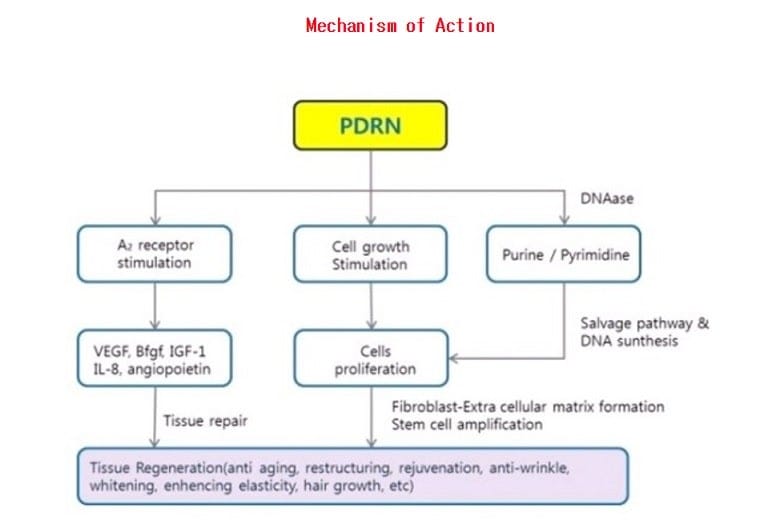
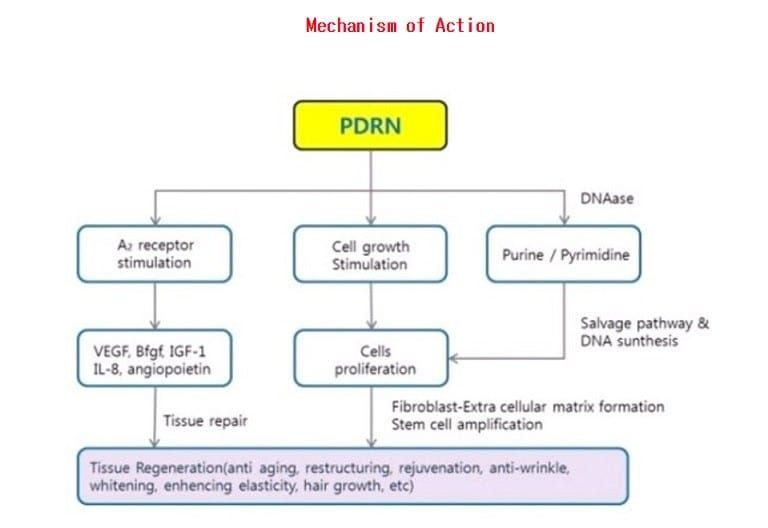
As shown in the diagram above, the DNA fragment PDRN promotes the secretion of various cytokines involved in regeneration and increases cell proliferation, thereby rejuvenating tissue—in other words, it triggers regeneration, recovery, and renewal.
3. Effects on hydration and pore size
- Rejuran is beneficial for dry skin and also highly effective for enlarged pores.
- The improvement that patients tend to notice first is relief from dryness and a tight, dehydrated sensation in the skin.
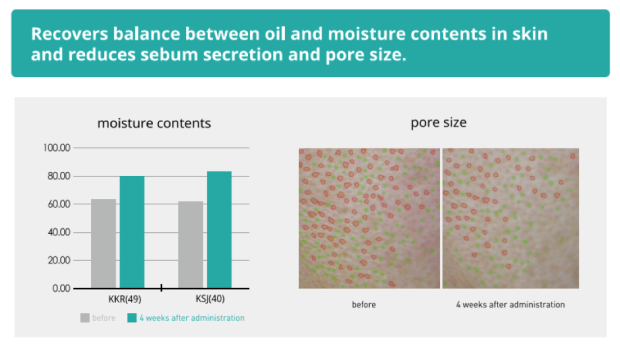
- As demonstrated in the study referenced above, measurable improvements in skin hydration and a visible reduction in pore size have been observed.
- It naturally follows that skin texture and skin tone improve as well.
4. Is it different from a filler?
- Some patients confuse Rejuran with a dermal filler because the name sounds similar to 'filler' in Korean.
The manufacturer appears to have named it 'Healer' because it regenerates tissue—and it is an entirely different substance from a filler.
Dermal fillers are made of hyaluronic acid (HA), whereas Rejuran contains PN.
HA can improve skin hydration, and cross-linked HA fillers create volume in areas such as the nose, chin, and forehead.
PN, however, does not create volume. So to answer the question 'Can I get Rejuran instead of a nose or chin filler?'—the answer is no.
That said, the under-eye area is an exception: with repeated Rejuran treatments, patients often report a gradual plumping and firming sensation in a previously hollowed under-eye area.
5. Is it painful?
- Unfortunately, there is some discomfort. Some patients compare it to skin botulinum toxin injections.
Because PN has a larger molecular weight than PDRN, there tends to be a degree of pain as the solution is injected. However, nerve block anesthesia can make the procedure considerably more comfortable.
- Personally, I find it painful, but the results are good enough that I tolerate it.
6. How many sessions are needed to see results?
- Initially, approximately 4 sessions spaced 3–4 weeks apart (2–3 weeks is also acceptable) are recommended, after which maintenance treatments can be scheduled as needed.
- Results are noticeably more pronounced at the second session compared to the first, and improvement tends to continue progressively up to around the fourth session.
7. Are there any side effects?
- As I always explain to patients, if Rejuran has a 'side effect,' it would be that some individuals feel the results are less pronounced than expected. In that case, increasing the dose or frequency of sessions generally helps.
The point is that there are very few side effects worth mentioning.
Very rarely, Rejuran may trigger a hypersensitivity reaction in patients who have previously received cross-linked HA fillers; in such cases, dissolving the filler with hyaluronidase and allowing time to pass resolves the issue. Side effects from Rejuran itself are considered to be very rare.
That covers the main points. If you have any questions, please feel free to ask.
+ One more important note: the effects of Rejuran are dose-dependent. The standard dose is 2 cc per syringe (except for Rejuran I, which is formulated specifically for the under-eye area). At a minimum, 2 cc should be administered per session to cover both cheeks (excluding the forehead); if the forehead is included, at least 3 cc or more is needed.
- If you encounter a clinic offering Rejuran at a price that seems unrealistically low (the cost of the product itself is quite high), it is worth confirming whether the dose being used is only 1 cc. Receiving 1 cc across the entire face is unlikely to produce meaningful results—something to keep in mind.