Acne Treatment with PDT: Side Effects, Chlorophyll PDT Explained, and PhotoQ PDT
Learn how PDT photodynamic therapy treats acne by targeting sebaceous glands, and why chlorophyll a PDT offers fewer side effects than ALA-based options.
There are many causes of acne, but when we look at the big picture, they can generally be grouped into three main categories:
1. Excess sebum (oil) production
2. Clogged hair follicle openings due to dead skin cells → sebum cannot be expelled
3. Overgrowth of acne-causing bacteria (P. acnes)
When excess sebum production is the primary cause, a treatment called PDT (Photodynamic Therapy) can be used to regulate overactive sebaceous glands and treat acne.
PDT — Photodynamic Therapy — works by applying a light-sensitive photosensitizing agent to the face. After a set period, light is applied, causing the photosensitizer to react and generate reactive oxygen species (ROS) within the targeted cells, ultimately destroying them.
In simple terms: a light-reactive substance is applied to the skin, and when light is shone on it, the substance reacts to destroy sebaceous glands and kill acne-causing bacteria.
The two most critical elements in PDT treatment are the 'light source' and the 'photosensitizing agent.'
For effective acne treatment, the photosensitizer must react sufficiently, carry a low risk of side effects, and be exposed for an appropriate duration to a specific wavelength of light that optimally activates that agent.
Commonly used photosensitizing agents include ALA, M-ALA, chlorophyll a, and IAA. ALA-based agents may cause erythema (redness) for several days after the procedure, require strict sun protection, and can occasionally lead to side effects such as post-inflammatory hyperpigmentation or significant tanning.
The photo above shows the appearance of a patient on day 3 following an ALA-based PDT procedure.
The erythema (redness) is more pronounced than many patients expect. During this period, it is advisable to avoid going outdoors as much as possible. Exposure to sunlight or UV radiation at this stage can cause the redness to persist for an extended time or may result in significant tanning.
The type of reaction described above is a common occurrence when using ALA-based photosensitizing agents, and side effects are not infrequently experienced. ALA and M-ALA have the additional drawback of remaining in the skin for approximately 2–3 days after the procedure, which is a relatively long residency time. This extended presence can lead to side effects such as phototoxicity.
In recent years, chlorophyll a PDT — which carries a lower risk of side effects — has become more widely used. Our clinic also uses a chlorophyll a PDT product (currently using PhotoQ PDT).
Chlorophyll has a very short residency time in the body — under one hour — meaning it is almost entirely eliminated from the body shortly after the procedure. It also has the advantage of not causing side effects such as erythema or swelling.
With chlorophyll PDT, the pronounced redness seen in the procedure photos above is not observed at all.
Chlorophyll a responds most effectively to light at 660 nm. The light source used at our clinic is also 660 nm (red light), which creates a synergistic effect.
Chlorophyll PDT is an active area of ongoing research due to its favorable efficacy profile and low side-effect risk.
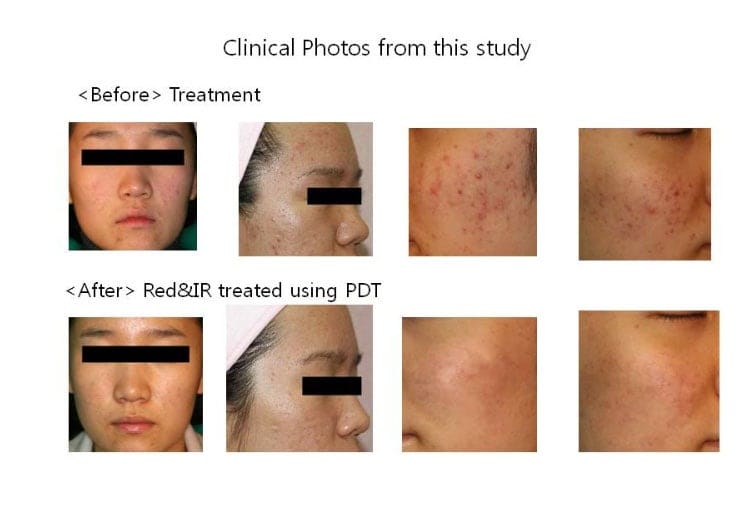
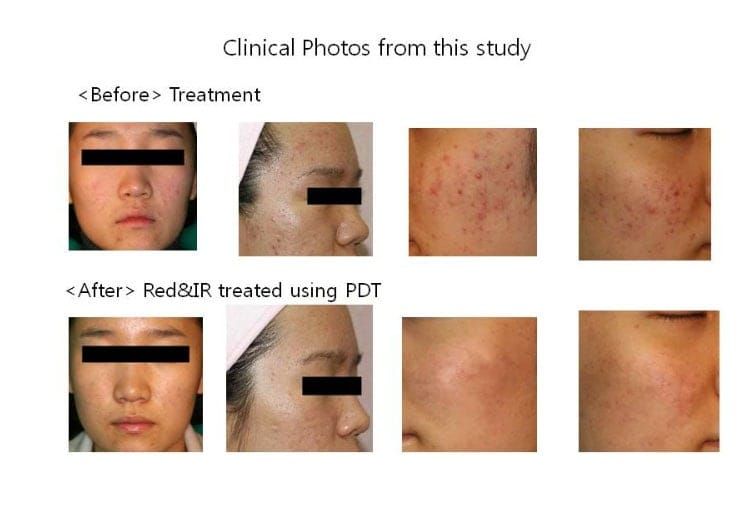
The before-and-after photos below are from a chlorophyll PDT study published in a domestic Korean dermatology journal.
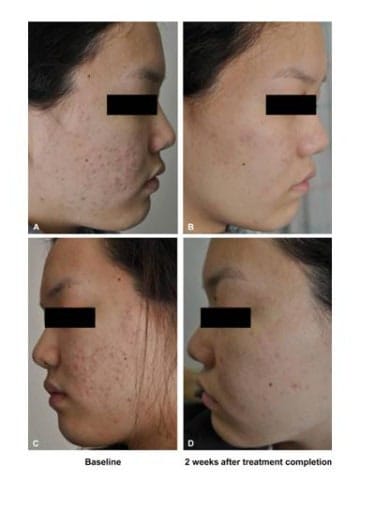
This set of photos is also from a publication in a domestic Korean dermatology journal.
The patient underwent a total of 8 or more treatment sessions, and the results are notably favorable.
Because chlorophyll PDT carries very few side effects even with repeated sessions, consistent treatment at a frequency of once per week is recommended.
(At our clinic, a 5-week program with one session per week is our most popular option.)