Breakouts After Laser Toning or Hair Removal — Side Effect or Normal?
Learn why breakouts sometimes occur after laser toning or hair removal and what you can do to minimize them, explained by the dermatologists at Dayone Clinic.

Occasionally, patients come in reporting breakouts or acne after receiving laser treatments (such as laser toning or hair removal laser).
For those experiencing this for the first time, questions naturally arise: Is this a side effect? Should I stop getting treatments?
From a clinical perspective, however, this is something that can naturally occur and is considered part of the treatment process.
Q. Is it a problem with the equipment or the provider (clinic)?
A. No. It can happen to anyone, and the likelihood is somewhat higher in individuals with more active sebaceous glands compared to others.
So, why do breakouts occur after laser treatment?
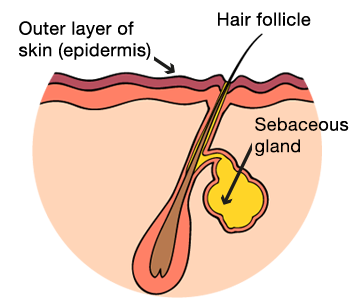
Here is a simple diagram of the epidermis and its appendages.
As shown in the illustration, most sebaceous glands are connected to hair follicles, forming a single "pilosebaceous unit."
As many people know, the sebaceous gland plays a central role in the development of breakouts and acne.
Laser toning and hair removal lasers generally target pigment in the dermal layer.
The 1064 nm wavelength commonly used in laser toning, as well as the 755 nm wavelength frequently used for hair removal, both have high absorption by melanin pigment.
Because our hair also contains melanin, it appears black or brown.
During laser treatment, areas of hair and hair follicles containing melanin absorb more laser energy than surrounding tissue, generating heat.
This is precisely the point that can lead to post-laser breakouts.
The sebaceous glands connected to the hair follicles — as described under the "pilosebaceous unit" — can be stimulated by the heat that accumulates in the follicle during laser treatment, leading to increased sebum production compared to normal levels.
There are other contributing factors as well, but the above is the simplest explanation for easy understanding.
So, what can be done to minimize breakouts after laser treatment?
Sufficient cooling of the skin after the procedure is recommended to bring down the heat. Many clinics provide post-treatment care on site, but at home it is also helpful to apply a cold towel compress, a saline-soaked pad, or a cold pack if possible.
Some patients report that breakouts occur more easily after hair removal laser treatments.
(This is especially common in men receiving facial hair removal.)
In these cases, the issue tends to occur more frequently when a blade razor is used before the session — particularly when the blade is reused rather than treated as single-use, or when the razor is stored in a humid environment such as a bathroom, where bacterial growth occurs more readily.
Therefore, those who use blade razors are advised to use a fresh blade each time and to store the razor in a location with low humidity.
If a significant number of breakouts appear after laser treatment,
do not hesitate to visit the clinic for care — that is the best course of action.
Breakouts that occur in the way described above are a natural phenomenon and cannot strictly be called a laser "side effect."
We hope this explanation helps you better understand what is happening.


