Acne Treatment – PDT (Photodynamic Therapy) Program
Tox & Fill Clinic Sinnonhyeon explains their PDT (Photodynamic Therapy) acne treatment program, including the step-by-step process, side effects, and combination options.
Hello!
This is Tox & Fill Clinic, Sinnonhyeon branch.
We'd like to explain PDT, one of the acne treatment programs we offer at our clinic.
PDT stands for Photodynamic Therapy. A light-sensitive photosensitizing agent is applied to the face, and after a set incubation period, light is directed onto the skin. The agent reacts to the light, promoting the generation of reactive oxygen species inside the targeted cells, which leads to cell destruction.
In simple terms: a light-reactive substance is applied to the skin, and when exposed to light, it reacts to break down the sebaceous glands and eliminate acne-causing bacteria.
For mild acne, we combine scaling with PDT therapy in an approximately 5-week program. Because results vary from person to person, we generally recommend 5 to 10 sessions.
Let's take a closer look at how the PDT acne treatment program at Tox & Fill Sinnonhyeon is carried out.
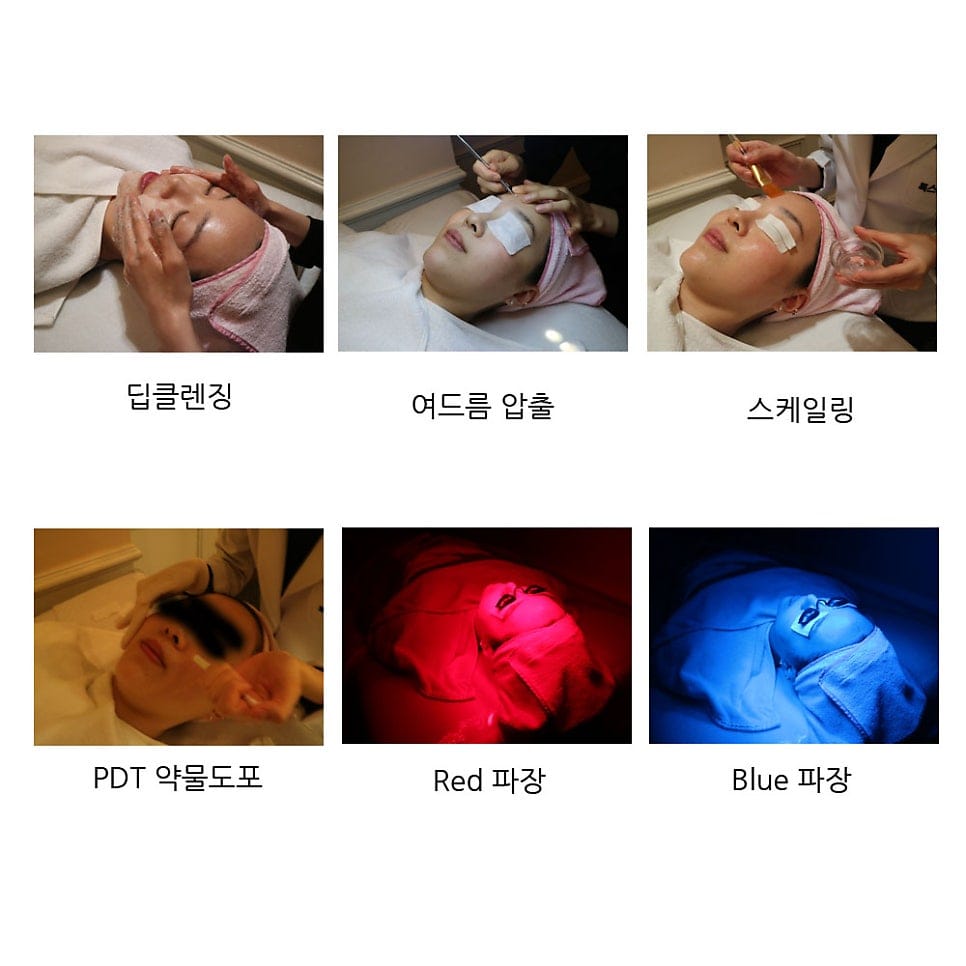
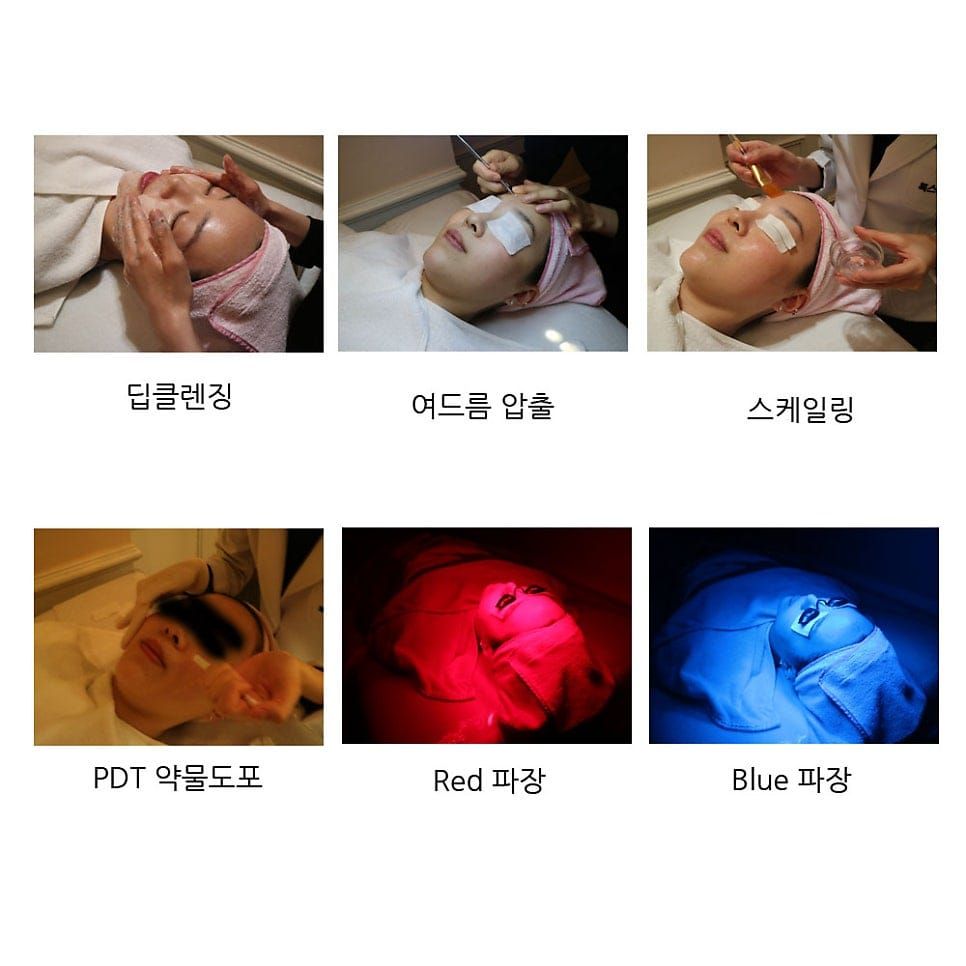
The process begins with a deep cleansing, followed by acne extraction.
Next, scaling is performed to remove dead skin cells, after which the PDT solution (Chlorophyll-a PDT or Photo-Q PDT) is applied.
After the solution is applied, a dark-room incubation period of approximately 10 minutes follows.
The skin is then exposed to light at the optimal wavelength for PDT activation for about 30 minutes — first red light for approximately 20 minutes, then blue light for approximately 15 minutes.
Finally, a modeling pack is applied as the last step (not shown in the photos).
Q. Is the procedure painful?
A. In the PDT program, a mild stinging sensation may be felt only during the acne extraction step. The application of the PDT solution and the light exposure itself cause little to no discomfort. Sessions are also conducted in a private room for your comfort.
Q. Are there any side effects?
A. With the ALA solution that was commonly used in the past, side effects such as redness lasting 2–3 days, pigmentation, and swelling could occur. However, the Chlorophyll PDT solution currently used at our clinic has very few reported side effects, and the PDT solution itself is fully broken down by the body by the end of the session. Since no residual agent remains, there is little concern about side effects.
Q. Are there complementary treatments?
A. Combining PDT with Aladdin Peeling or scaling can enhance results. Currently, our most popular package is the Acne Elimination Program: 1 session of Aladdin Peel + 5 sessions of PDT (scaling included).
In cases of severe acne, sebum control with PDT alone may be insufficient. In such cases, the Agnes laser can be used to directly target and destroy the sebaceous glands of stubborn or frequently recurring inflamed acne lesions.
For those with significant inflammatory acne or frequent recurrence, combining Agnes with PDT may provide greater overall results.