Why Skin Ages and How Lifting Treatments Work
Learn why facial skin loses elasticity with age and how lifting treatments — from HIFU to thread lifting — target each skin layer to restore a youthful contour.
Everyone wants to slow down aging and maintain a youthful, firm appearance.
Yet many people begin to notice the first signs of aging in their late twenties, and by their thirties they find themselves sighing in front of the mirror more often than before. 😔
That is precisely why lifting — the treatment that defies aging — could be called the crown jewel of aesthetic skin procedures. After all, it works against both gravity and time. 😊
These days, patients ranging from young adults in their twenties all the way to those in their sixties and seventies are visiting our clinic with interest in lifting treatments.
Patients in their twenties (mostly late twenties) often come in feeling alarmed the moment they start noticing the first signs of aging, while older patients tend to visit after seeing the results in friends, or are brought in by their adult children.
Recently, a certain celebrity's remarkably age-defying appearance seems to have sparked even greater public interest in lifting procedures.
So — why exactly does facial skin lose its elasticity? Why does the face age and sag as the years go by?
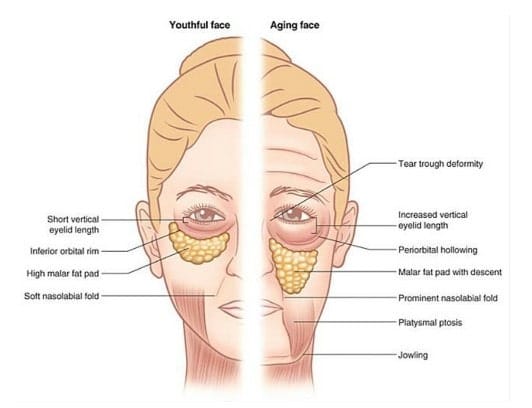
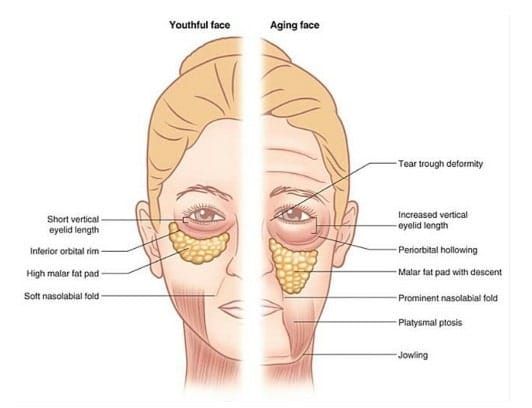
The illustration above presents a clear, straightforward depiction of how aging progresses. The left side represents a younger face, while the right side shows the point at which aging has advanced, facial contours have softened, and sagging has set in. As the image shows, various anatomical structures undergo changes as aging progresses.
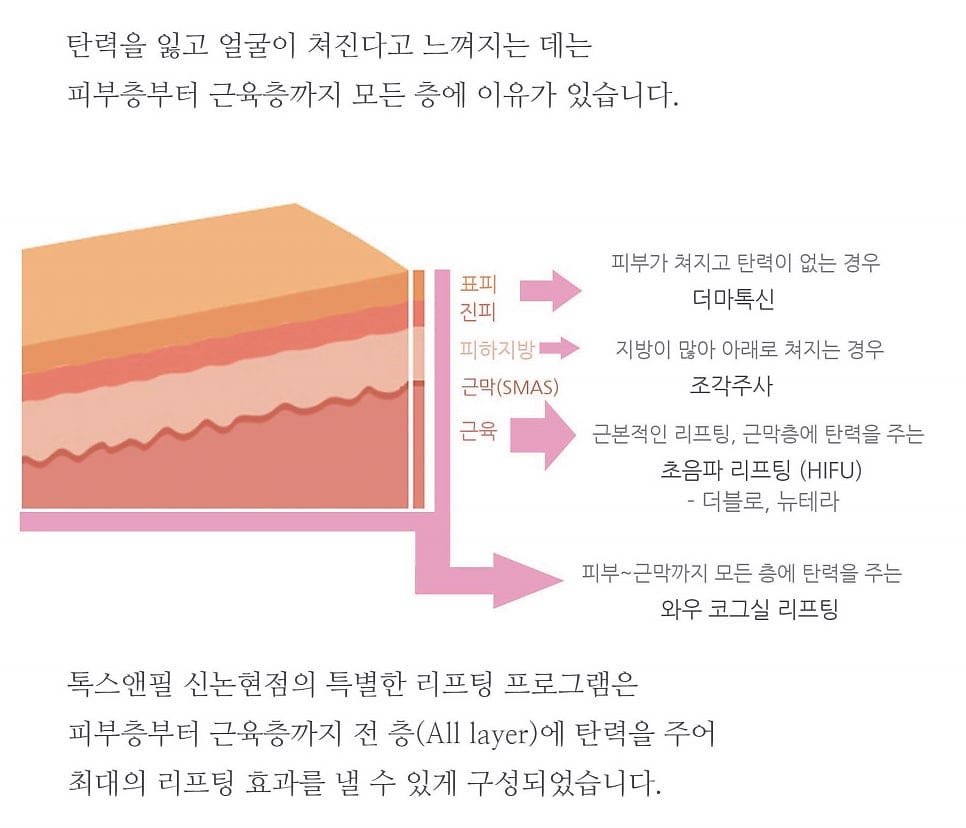
The illustration above is taken from our clinic's lifting brochure.
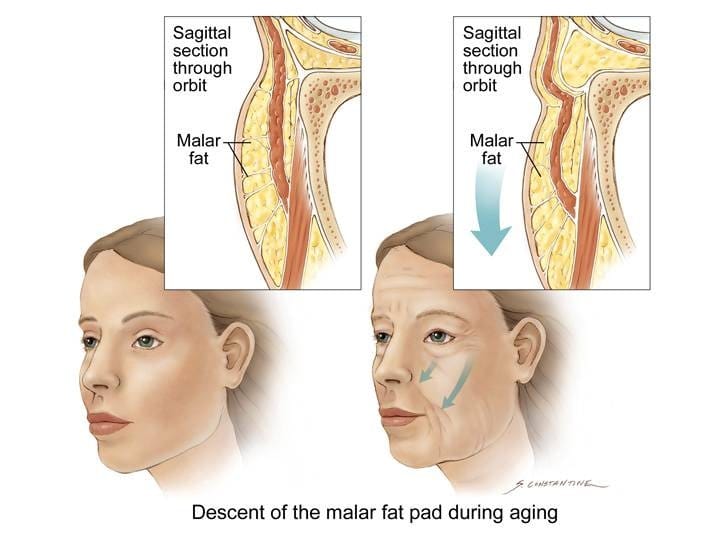
Our skin is composed of layers — from the outermost surface inward: the epidermis, followed by the dermis. Beneath that lies the subcutaneous fat layer, and below that, the muscle. As aging progresses, all of these layers are pulled downward by gravity and sag over time.
Collagen in the dermis decreases with age. Since collagen acts as a structural support framework, as it diminishes the skin begins to lose its firmness and sag — and the fat layer beneath it follows. Fat tends to increase in volume with age, and as the overlying skin layers sag, the fat layer itself is also displaced downward.
As shown in the illustration above, with aging the fat layer descends (shown in yellow), and the SMAS layer (shown in red) also loses elasticity and sags downward.
SMAS stands for Superficial Muscular Aponeurotic System — put simply, it is the fascia (connective tissue sheath) that surrounds the facial muscles. The SMAS layer is the most critical structure in lifting. It is the primary target layer in surgical lifting procedures (rhytidectomy / facelift) as well.
When planning a lifting treatment, the following considerations apply:
1. Loss of skin elasticity — treatments that stimulate collagen production in the dermis, such as Dermatoxin, Needle RF, Fraxel laser, or thread lifting.
2. Excess fat contributing to further sagging — fat-reducing injections (e.g., lipolytic injections), HIFU (High-Intensity Focused Ultrasound) lifting, which can also partially reduce fat, or thread lifting, which can mechanically lift and reposition sagging fat.
3. Restoring firmness to the fascial layer — surgical facelift (rhytidectomy) targeting the SMAS, or non-surgical options such as HIFU lifting or thread lifting that can reach and lift the fascial layer.
For younger patients seeking preventive treatment against early aging, it is not necessary to address every layer — treatment can be focused on whichever layer is of concern.
However, as aging advances, lifting treatments achieve the best results when all layers are addressed together. This is why there are so many different types of lifting procedures, and why relying on a single treatment alone will inevitably produce limited results.
That covers the general overview of lifting for now. 😊
In the next post, we will go into more detail on each treatment.