Pores & Acne Scar Treatment: Fraxel, Palomar Starlux XD, and Icon XD Laser
Learn about fractional laser options for enlarged pores and acne scars in Seoul, including Fraxel, Palomar Starlux XD, and Icon XD treatments explained by a Korean clinic.
In clinical practice, enlarged pores and acne scars are among the most common concerns patients bring up — right alongside melasma and dark spots.
Pigmentation issues require lasers that target pigment, while pores and scars require lasers that stimulate collagen production.
What people commonly call 'Fraxel' is often used as a general term for 'fractional laser.' Strictly speaking, 'Fraxel' is the brand name of a fractional laser developed by the U.S. company Reliant, but in everyday usage the term 'Fraxel' tends to refer to fractional lasers as a category.
(This is similar to how 'Botox' is technically a brand name by Allergan, yet people commonly use it to refer to all botulinum toxin products.)
Fractional lasers are classified into several types based on the medium used. The most commonly used categories are:
1. CO2
2. Erbium:YAG
3. Erbium:Glass
Needle RF devices such as Infini and Intracel can also be considered a form of fractional treatment, in that they create columns of thermal energy within the dermis.
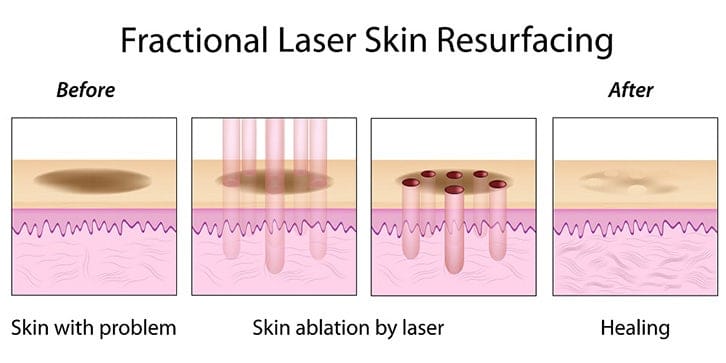
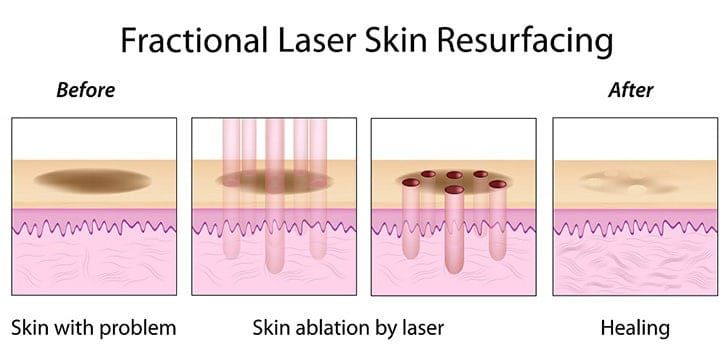
Early fractional lasers were predominantly ablative fractional lasers, such as the CO2 fractional laser. The principle involves fractionally ablating the epidermis to induce a regenerative response in the damaged skin.
Erbium:YAG, which has a higher water absorption rate than CO2, is also used; however, epidermal damage remains unavoidable, and there is a risk of side effects such as post-inflammatory hyperpigmentation.
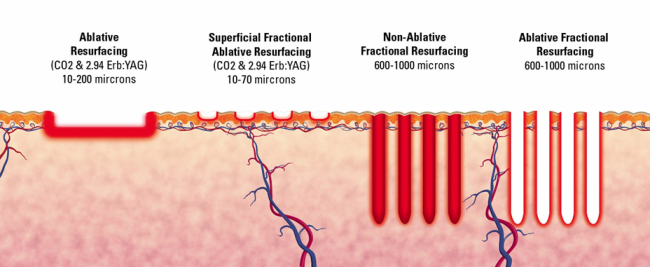
Because CO2 and Erbium:YAG cause considerable epidermal damage and do not deliver energy very deeply, the non-ablative fractional laser was developed to address these limitations (shown second from the right in the diagram above).
This category primarily includes Erbium:Glass-based fractional lasers. Rather than damaging the epidermis, they deliver energy directly to the dermis, creating thermal columns that stimulate the dermis and promote collagen production. Because epidermal damage is minimal, the risk of side effects such as hyperpigmentation is significantly lower than with ablative fractional lasers, and downtime is short — allowing patients to return to daily activities with minimal disruption.
Well-known non-ablative fractional lasers using Erbium:Glass include Reliant's Fraxel (Fraxel Re:Fine, Fraxel Dual, etc.), the Palomar Starlux XD, and the Palomar Icon XD — all from the United States.
The Palomar Starlux XD used at our clinic is based on the established 1540 nm non-ablative fractional platform and incorporates Palomar's patented XD microlens technology.
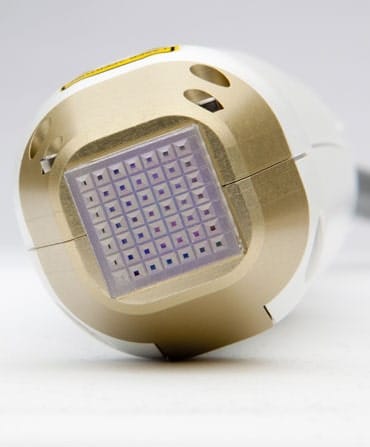
The tip is shaped like a sapphire crystal. When pressed firmly against the skin during treatment, it delivers energy deeper into the dermis while causing less epidermal damage compared with other fractional lasers — this is its key advantage.
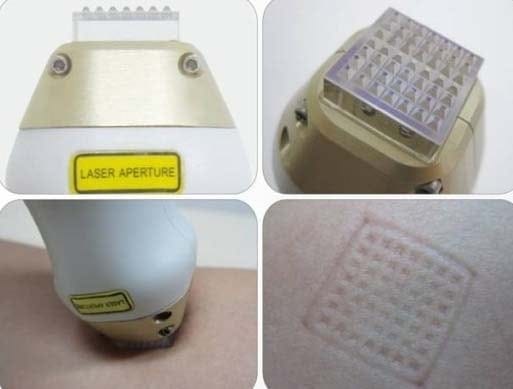
Redness and swelling are mild and typically subside within one to two days due to minimal epidermal damage.
Immediately after the procedure, the imprint pattern from the tip is visible (as shown in the lower-right photo), but it fades gradually and is generally barely noticeable after about one day. (In some cases, faint tip marks may remain for two weeks to one month, though they are typically not very conspicuous.)
Downtime is noticeably shorter than with other fractional lasers, making this treatment well suited for patients who need to return to their daily routines promptly.
With numbing cream applied beforehand, discomfort is mild — generally described as a slight stinging sensation. Adequate cooling immediately after the procedure helps redness settle quickly, so the impact on daily activities is minimal.
The Starlux XD (and the Icon XD, which is essentially the same platform under a newer name) creates deep thermal columns within the dermis, actively stimulating collagen production through the heat energy delivered to the dermal layer.
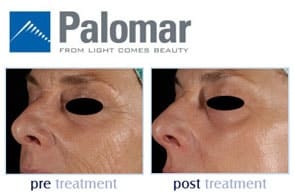
Before-and-after photos provided by Palomar.
As collagen remodeling progresses, overall skin elasticity improves and the appearance of wrinkles may also be reduced.
The day after treatment, mild swelling can temporarily make pores appear smaller; actual improvement typically takes around three to four weeks. After the collagen remodeling process within the dermis, patients may notice improved skin firmness, reduced pore appearance, and gradual filling of scars from the base upward. An overall brightening of skin tone has also been observed.
For deeper scars, non-ablative fractional laser treatment may be combined with Erbium:YAG or CO2 fractional laser — sometimes referred to as 'double fraxel' or 'triple fraxel.' The principle is to resurface from above while building thermal columns from below, allowing regeneration to occur in both directions simultaneously.
Because pores and scars fill in slowly relative to their depth, repeated treatments are generally necessary. Five or more sessions are typically recommended, and results may vary depending on the depth of the scarring.