IPL, Light Absorption, and MaxG (Palomar) — Explained by Day One Clinic Gangnam
Discover how IPL and the Palomar MaxG work for pigment and vascular treatment at Day One Clinic Gangnam, including key differences between domestic and imported IPL devices.

Even people who have never visited a dermatology clinic have heard of IPL — it is one of the most widely recognized procedures in the field.
While long-pulse devices have grown in popularity and IPL usage has declined somewhat in recent years, IPL remains one of the treatments capable of delivering the most visible results when used properly.
The performance gap between domestic Korean IPL devices and imported original devices — such as the Palomar MaxG or the Lumenis One — is quite significant. Clinics without access to original imported devices relied heavily on domestic IPL for some time, but many have since shifted toward long-pulse systems. At clinics that do have original imported IPL equipment, however, IPL continues to be highly valued for its results.
(In my view, IPL shows the largest performance difference between domestic and imported devices of any laser category. Domestic devices perform reasonably well for HIFU, hair removal, and Nd:YAG when used correctly, but the gap is especially pronounced with IPL — particularly when treating faint or subtle pigmentation.)
With that said, let's take a closer look at IPL, a name most people recognize but may not fully understand.
IPL stands for Intense Pulsed Light. Strictly speaking, it is not a laser. Clinics often use the term "laser" loosely when describing various devices, but IPL is technically not a laser.
A laser uses a specific medium to emit light at a specific wavelength, whereas IPL does not rely on a medium at all. Instead, it uses a xenon flash lamp to emit broad-spectrum light across a range of wavelengths, delivered in intense pulses.
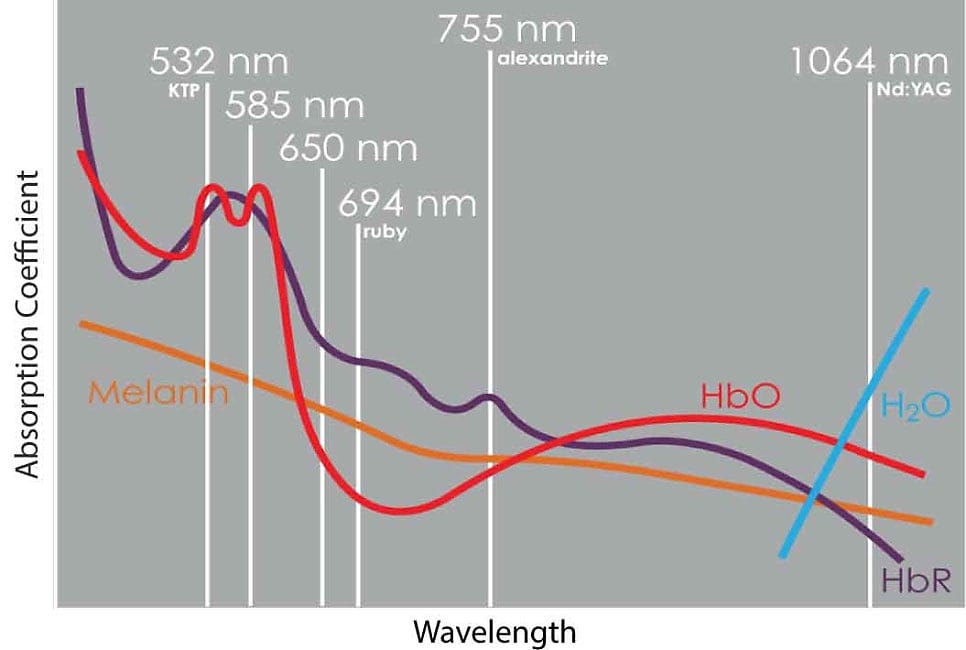
As discussed previously, we use the principle of Selective Photothermolysis for pigment treatments. As shown in the absorption graph, each chromophore has its own preferred wavelength — meaning it selectively absorbs certain wavelengths of light. By targeting those wavelengths, light energy is converted into heat, destroying the target tissue at high temperatures. That is the basic concept in simple terms.
A standard IPL flash lamp emits light in the 400–1200 nm range. During treatment, cut-off filters are used to allow only an appropriate range of wavelengths through. In most cases, a 560 nm or 590 nm cut-off filter is applied, eliminating shorter wavelengths and using light in the 560–1200 nm or 590–1200 nm range.
The Palomar MaxG is distinctive in that it uses two cut-off filters, allowing an even narrower range of wavelengths to be delivered. It emits light only in the 500–670 nm and 870–1200 nm ranges. As a result, it carries significantly fewer side effects than conventional IPL devices while delivering more effective results.
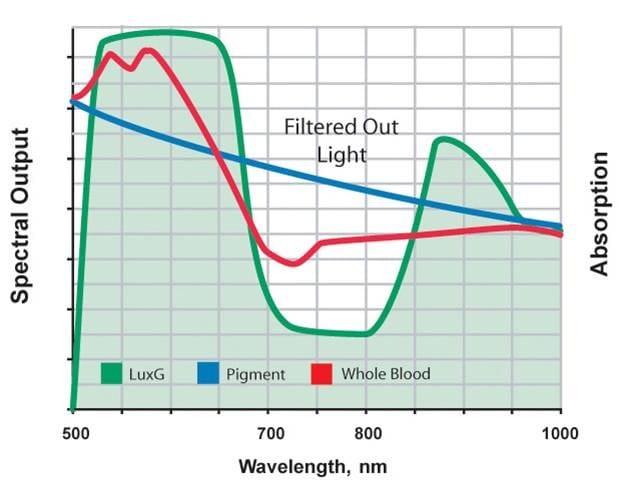
In the graph, blue represents melanin absorption and red represents hemoglobin (Hb) absorption. The green-highlighted range (labeled LuxG) indicates the dual-filtered wavelength range of the MaxG.
The 500–670 nm band targets Hb and melanin, while the 870–1200 nm band targets Hb and MetHb, making MaxG useful for both pigment treatment and vascular treatment simultaneously.
Our clinic has both a domestic IPL device and the original Palomar MaxG, and the difference in performance between the two is substantial. One of the key advantages of the MaxG is that it produces significantly fewer cases of post-inflammatory hyperpigmentation (PIH) compared to domestic or standard IPL devices. Even more notably, it responds effectively to faint, subtle pigmentation.
(This is what we consider the most important difference between domestic and original imported IPL devices, and why we recommend seeking out original equipment for IPL treatment. Faint pigmentation will not improve no matter how many sessions are done with a lower-quality device. Higher-quality machines tend to respond much better to subtle pigmentation.)
We will cover the MaxG in more detail in a future post.
Returning to general IPL:
Q. Who tends to see the best results from IPL?
A. IPL is most effective for superficial epidermal pigmented lesions such as age spots and freckles. The results can be very noticeable in just two to three sessions, making it one of the treatments with the highest patient satisfaction.
As the absorption chart also shows, IPL's broad-spectrum light allows it to target multiple chromophores in a single session. In addition to pigment treatment, wavelengths with high hemoglobin absorption are also emitted, enabling vascular lesions to be addressed at the same time.
With repeated sessions, a clear skin rejuvenation effect is also observed — patients often notice an improvement in skin luminosity. This is thought to occur because the combined light energy of IPL reaches the dermal layer, causing controlled breakdown of dermal collagen, which then stimulates fibroblast activity to synthesize new collagen as part of the healing process. For photorejuvenation effects, approximately 4–5 sessions are recommended, and results typically become noticeable gradually about 2–3 weeks after each treatment.
Q. What are the potential side effects of IPL?
A. Individuals with darker skin tones, those who have tanned recently from sun exposure, or those whose skin darkens easily in the sun have a higher concentration of IPL chromophores such as melanin in their skin. Treating these patients at a standard energy level can cause an excessive reaction. Scabbing in the shape of the IPL tip may occur, and this can potentially result in post-inflammatory hyperpigmentation (PIH).
1. There is a significant performance difference between domestic and imported IPL devices.
2. Individuals with darker skin or those who tan easily should receive IPL at a very low energy setting.
3. People with many freckles or age spots tend to see excellent results. Note: this does not apply to melasma.
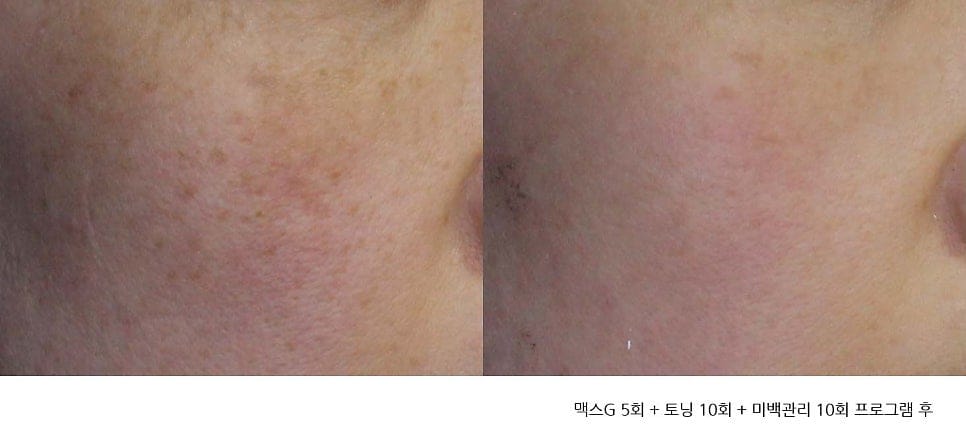
Below are actual before-and-after photos from treatments performed at our clinic.
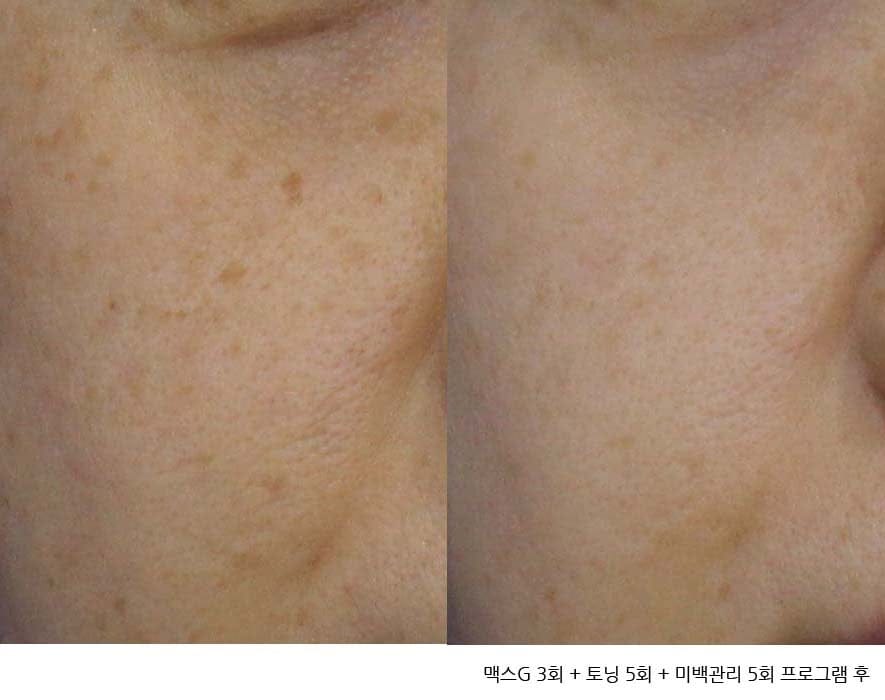
Left: before treatment. Right: after treatment.
Looking at the photo on the left, the patient may have perceived these pigmented spots as prominent, but in fact, this type of light brown pigmentation tends not to respond well to standard IPL devices.
After MaxG treatment, the pigmentation is noticeably lighter than before, and overall skin tone appears brighter.
A rejuvenation effect is also evident, with visible improvement in skin texture.
This patient shows a similar result.
As seen in the left photo, this type of brown pigmentation is difficult to treat with standard IPL.
A combination of MaxG and laser toning has produced clear improvements in pigmentation as well as skin texture and pore appearance.
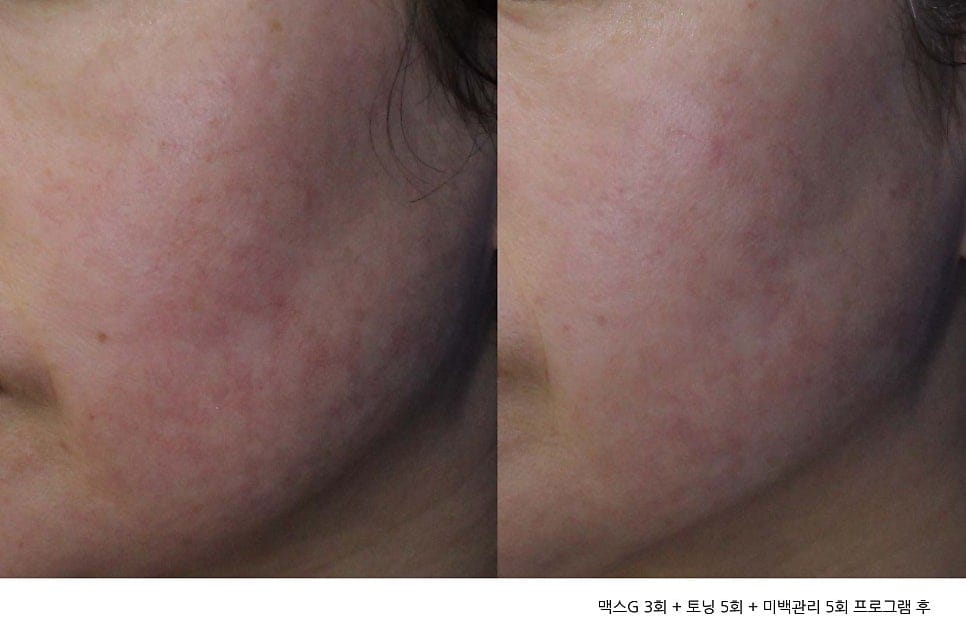
Redness and flushing require multiple repeated sessions and can be challenging to treat even with dedicated vascular lasers; however, IPL and MaxG can also provide a degree of improvement for these concerns.
In the photo above, a noticeable reduction in vascular redness is visible. With continued regular sessions, further improvement can be expected.