Laser Fundamentals: Photothermal Effect and Thermal Relaxation Time (TRT) Explained — Day One Clinic Gangnam
Learn the basics of laser science — photothermal effect, thermal relaxation time (TRT), and selective photothermolysis — explained by Day One Clinic Gangnam.
There are three main ways lasers produce effects in tissue:
1. Photothermal effect
2. Photomechanical effect
3. Photochemical effect
While all three concepts are important, the photothermal effect is arguably the most fundamental, so let's start there.
Photothermal Effect
When laser energy is absorbed by tissue, light energy is converted into heat energy, raising the temperature of the tissue. The degree of thermal damage depends on the temperature reached: below 50°C, tissue changes are reversible and the tissue can return to its normal state after treatment. Between 60°C and 100°C, however, tissue proteins denature or coagulate, causing irreversible thermal damage and tissue necrosis. Blood coagulation occurs between 68°C and 90°C, and at temperatures above 300°C, complete tissue vaporization takes place.
The depth and extent of thermal damage determine whether scarring or post-inflammatory hyperpigmentation occurs after a procedure. Because each laser has a different wavelength, penetration depth, and degree of scattering, the depth at which thermal damage occurs also varies from laser to laser.
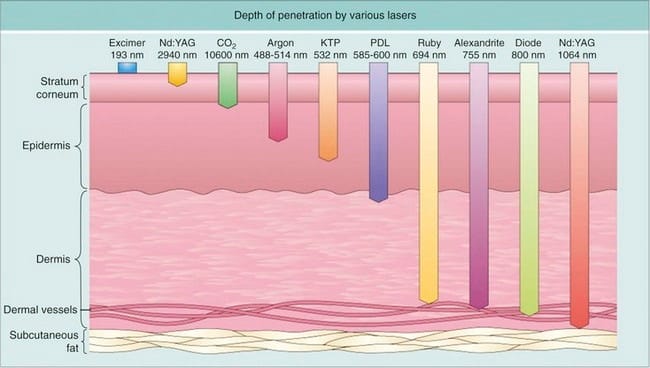
As illustrated in the diagram above, different types of lasers penetrate to different depths. To use the right laser for a given purpose, it is essential to understand how deeply each laser can penetrate.
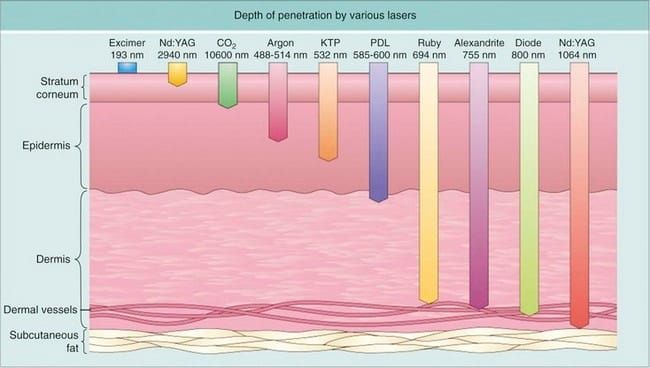
CO₂ lasers penetrate only about 0.1 mm and are highly absorbed by water, so they scatter very little in the superficial layers of tissue. Nd:YAG lasers, by contrast, are less absorbed and scatter more as they travel, allowing them to penetrate deeply — reaching depths of 4–6 mm.
Penetration depth matters, but so does the concept of the chromophore — the skin component that absorbs light. The primary chromophores targeted in laser treatments include water, hemoglobin, melanin, and tattoo pigment. Each chromophore selectively absorbs specific wavelengths. When a laser wavelength is chosen that is preferentially absorbed by a target chromophore, scattering is minimized and absorption is maximized, concentrating thermal damage in the intended target.
This brings us to another key concept: Selective Photothermolysis. This principle is essential for treating skin conditions. If a laser beam that is selectively absorbed by the target tissue is applied for a duration shorter than the Thermal Relaxation Time (TRT), thermal damage is confined to the target tissue only, leaving the surrounding normal tissue unaffected.
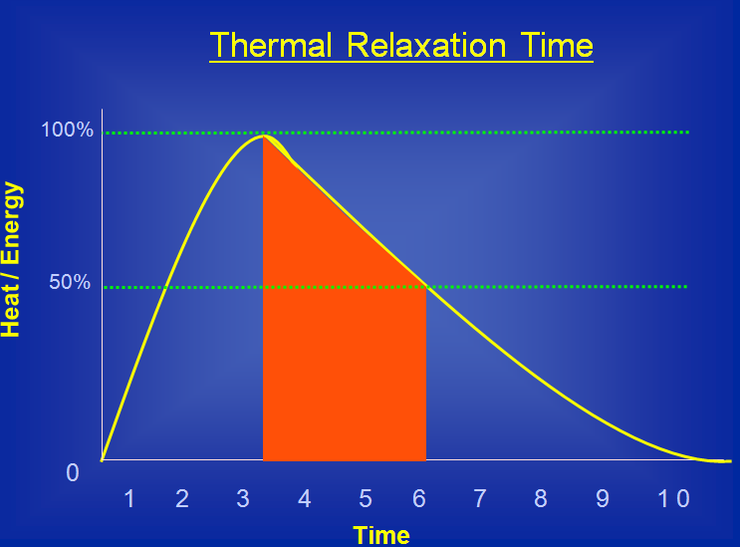
Thermal Relaxation Time (TRT) is defined as the time it takes for a laser-irradiated target to cool to half of its peak temperature. In other words, it is the time required for the heat generated in the target chromophore — after absorbing light energy — to dissipate into the surrounding tissue until the temperature drops to one-half of its initial rise. TRT therefore represents the time the tissue needs to cool down. If the laser is applied for a duration shorter than the TRT, thermal damage is selective to the target tissue and surrounding normal tissue is spared.
When laser exposure lasts too long, heat conducts not only through the target tissue containing the chromophore but also into the surrounding tissue, causing collateral thermal damage. This happens because heat energy remains concentrated in the absorbing tissue for only a limited time before it diffuses outward.
For this reason, it is critically important that the pulse width — the duration of laser irradiation — be kept shorter than the TRT of the target tissue.
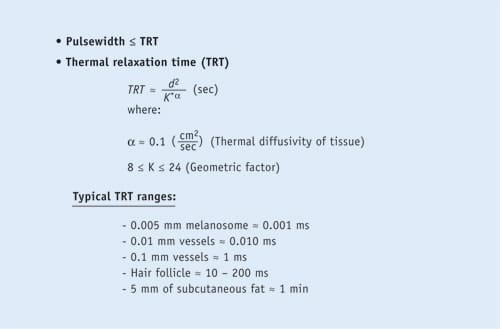
For the melanosomes (melanin granules) commonly targeted in treatment, a size of 0.005 mm corresponds to a TRT of approximately 1 microsecond (1 µsec). For blood vessels, the TRT varies with vessel size — a larger vessel of 0.1 mm diameter has a TRT of approximately 1 millisecond (1 ms).
In practice, applying Selective Photothermolysis requires knowing the TRT of each specific target, setting the pulse width to a value shorter than that TRT, and selecting a laser with a wavelength and fluence sufficient to deliver an adequate amount of thermal energy to the target. This sounds straightforward in theory, but getting all of these parameters right in a real clinical setting is genuinely challenging. 😊
That covers the basics of the photothermal effect — the most important mechanism by which lasers act on tissue. Beyond the photothermal effect, lasers can also produce effects through the photomechanical and photochemical pathways.
The photomechanical effect, as the name implies, involves the mechanical destruction of target tissue. A classic example is tattoo removal with a Q-switched Nd:YAG laser, where tattoo pigment particles are mechanically shattered and then gradually absorbed and cleared by the body.
The photochemical effect can also occur when laser energy is absorbed by tissue. Low-level laser therapy (LLLT) using a He-Ne (helium-neon) laser, which is widely used in aesthetic and rehabilitative settings, is reported to promote collagen production and aid in the healing of damaged tissue. This biostimulation effect is considered a photochemical action. Photodynamic therapy (PDT), which uses laser light to activate a photosensitizing agent, is another example of a treatment that relies on the photochemical effect.
— Much of this content is drawn from 'Clinical Skin Care' by Jeong Jong-young. 😊