Skin Structure, Melanocytes, and Tranexamic Acid as a Melasma Treatment
Learn how tranexamic acid (Transamine) works as a melasma treatment by inhibiting melanogenesis, with a review of clinical studies, dosing, safety, and available products.
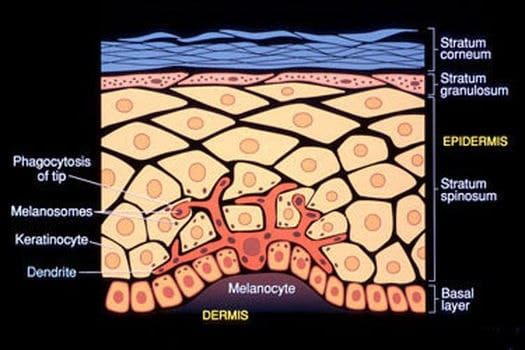
1. Skin Structure
- Composition: The skin is made up of three layers — the epidermis, dermis, and subcutaneous fat layer.
- Epidermis: Typically 0.05–0.1 mm thick. The primary cell type of the epidermis (~90%) is the epidermal keratinocyte, which undergoes a multi-stage differentiation process known as keratinization, giving rise to four distinct layers.
- Cells divide and proliferate in the basal layer, then migrate upward to form the spinous layer, followed by the granular layer, and finally the outermost layer — the stratum corneum.
- Dermis: Ranges from 0.5–5 mm in thickness depending on body region, generally 15–40 times thicker than the epidermis. It is composed mainly of connective tissue — including collagen and elastic fibers — and ground substance.
- Structures within the dermis include blood vessels, eccrine sweat glands, sebaceous glands, nerves, and lymphatic vessels.
- Subcutaneous fat layer (subcutaneous layer): Located beneath the dermis; composed predominantly of adipocytes (fat cells).
2. Melanocytes
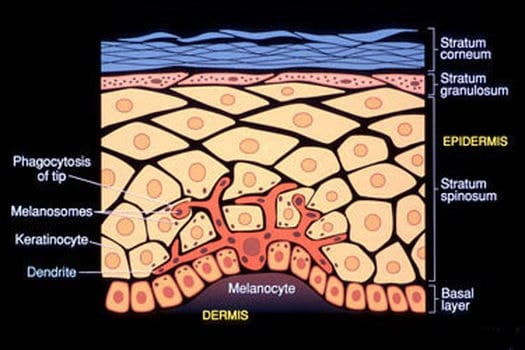
- Melanocytes are found primarily in the basal layer of the epidermis and increase in number with greater sun damage. In individuals without significant sun damage, the ratio of melanocytes to basal cells in trunk skin is approximately 1:10. However, in sun-damaged facial skin, this ratio can reach as high as 1:1.
- Determinants of skin color: Skin tone is not determined by the number of melanocytes, but rather by the number, size, and degree of melanization of melanosomes. Of particular importance are the size of melanosomes and their distribution within epidermal keratinocytes. In short — melanosomes are the key factor.
- Epidermal melanin unit: Each melanocyte forms a functional unit with approximately 36 keratinocytes. This is called the epidermal melanin unit, and it is responsible for supplying melanosomes to surrounding keratinocytes.
3. Melanogenesis
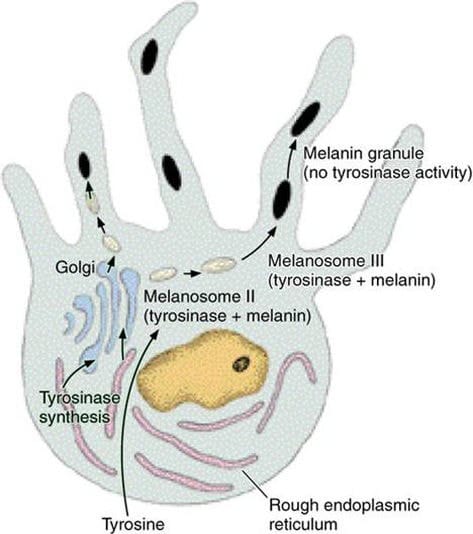
- Melanogenesis: The process by which melanin is produced within melanosomes in the cytoplasm of melanocytes. Tyrosine is oxidized by the enzyme tyrosinase, resulting in the synthesis of melanin.
4. Plasminogen and the Mechanism by Which Tranexamic Acid Acts on Melanogenesis
- Plasminogen is the precursor to plasmin and plays an important role in maintaining blood fluidity without causing coagulation. In its activated form, plasmin acts as a fibrinase — it hydrolyzes fibrin, the coagulation protein essential for hemostasis. (When bleeding occurs, platelets become encased in fibrin, forming a gel-like clot.) Therefore, excess plasmin leads to fibrin breakdown and impaired hemostasis.
- Plasminogen is also present in the epidermal basal cells of the skin. When UV radiation causes keratinocytes to bind with plasminogen, melanogenesis is enhanced — more precisely, by increasing levels of prostaglandin E2 and free arachidonic acid, which are known to stimulate melanogenesis.
- Tranexamic acid (TA): At its core, tranexamic acid is a plasmin inhibitor. It prevents fibrin from being hydrolyzed, thereby inhibiting bleeding — and has historically been used as a hemostatic agent.
- However, tranexamic acid also interferes with plasminogen binding in keratinocytes, thereby reducing UV-induced plasmin activity in those cells and suppressing melanogenesis.
5. Clinical Studies on Tranexamic Acid (TA) for Melasma
1) Sadako et al.: TA 1.5 g/day + Vitamins B, C, D — 4 weeks
2) Hajime et al.: TA 1–1.5 g/day — 10 weeks
3) Higashi et al.: TA 0.75–1.0 g/day — several months; improvement observed without side effects, but pigmentation recurred several months after discontinuation
4) Zhu et al.: TA 250 mg + Vitamin C 0.2 g + Vitamin E 0.02 g, three times daily — 6–8 weeks; authors suggest that extending treatment duration is more effective than increasing dose
5) Liu et al.: TA 250 mg + Vitamin C 0.3 g + Vitamin E 0.1 g, three times daily — 2 months
6) Wu et al.: TA 250 mg twice daily — 6 months
7) Mafune et al.: TA 750 mg three times daily — 8 weeks
8) Cho et al.: TA 500 mg/day combined with IPL and Nd:YAG laser — 6 months
(* Note: One domestic dermatology clinic routinely prescribes TA 1,000 mg + Vitamin C 2,000 mg for melasma.)
- Based on the existing literature, taking 250 mg two to three times daily was found to be effective — a substantially lower dose than that used for hemostasis (1.5–4.5 g/day). Clinical improvement was observed after at least one month of use, and treatment duration appears to matter more than dose.
- Side effects: GI upset (nausea, diarrhea, etc.) was reported in approximately 4–5% of cases; reduced menstrual flow was reported in approximately 3.5%.
6. Safety Profile and Side Effects of Tranexamic Acid
- Common side effects: GI disturbances (nausea, diarrhea) may occur.
- No teratogenicity or fetal effects have been reported; the U.S. FDA classifies TA as Pregnancy Category B. While it crosses the blood-brain barrier and placenta, excretion through breast milk is minimal.
- Cases of thrombosis, embolism, and stroke have been reported in patients with underlying medical conditions; however, multiple studies have shown that TA does not significantly increase the risk of thrombotic events. Nonetheless, caution is advised in patients over 50 years of age or those taking oral contraceptives.
7. Commercially Available Tranexamic Acid Products
- Transino (Boryung Pharmaceutical): Tranexamic acid 125 mg, pyridoxine HCl 1 mg, calcium pantothenate type S 6.17 g, L-cysteine 40 mg, ascorbic acid 50 mg — 2 tablets three times daily (TA 750 mg/day)
- Derma White (Hyundai Pharm): Tranexamic acid 125 mg, calcium pantothenate 4 mg, pyridoxine HCl 1 mg, coated ascorbic acid 53 mg, L-cysteine 40 mg — 2 tablets three times daily (TA 750 mg/day)
- Mesotherapy: In addition to oral administration, there is published evidence supporting the effectiveness of intradermal injection of TA over a 12-week course.
In summary, tranexamic acid can be used in dermatology without significant side effects. Oral doses of 500–750 mg per day taken for at least one month have shown clinical benefit. Results from studies of up to 6–8 months of use without adverse effects have been reported; however, a standardized long-term treatment protocol has not yet been established.